Friday, 6 February 2015

The Eastern Front Part 6 - The battles for Warsaw


The course of the Vistula from the
Carpathians to the Baltic, at Gdansk

          After their humiliation at Tannenberg, what a glittering prize the taking of Cracow and an advance into German Silesia must have seemed to the Russians. Despite their victories at Lemberg against the sub-standard Austro-Hungarian armies, they had been comprehensively outfought and out thought by the Germans in the north.  Not only would such a move now occupy German land and the road to Berlin, it would cut the direct route between Berlin and Vienna. They were egged on by the French, desperate for any actions that would detract from the German effort on the Western Front. Ironically, the threat to Cracow at this point compelled Germany to make its main advance on Warsaw itself. With similar logic to Prince Nicholas, Hindenberg saw it also as an ideal winter HQ, but it was his necessity to draw Russian pressure way from Cracow that precipitated the assault. For a while the wings of the opposing armies were wheeling gigantically clockwise, with the Russians looking to move west and north to threaten Silesia, and the Germans, from their strong positions in the north, looking to move south and west to pressurise and envelop Warsaw - and then through the centre would come some titanic and see-saw battles for the control of Poland. Hindenberg's initial moves towards Warsaw were held off at great cost, and then reversed by the Russians

The course of Poland's great river the Vistula dictated much of the action. From its source in the Carpathians, it winds north eastwards before turning back north west to run towards Warsaw . The key city of Ivangorod (today Deblin) fifty miles upstream was the only other crossing point of note. At Warsaw was the main crossing of the river for central Poland. Most of the city lay on the west bank, but its main railway station, the nodal point of the Polish lines was in the suburb of Praga across the river. The other opportunity to cross the Vistula lay in the narrowed section at Josefov. With a railway base at Ostroviets a few miles to the west the Germans had a good launch pad for an attempt. 
Sensing the attack through the centre that could ruin his own plans, the Crown Prince pulled all his forces behind the Vistula and the San (in the south), hence Ivanov’s significant withdrawal from near to Cracow. He still hoped to counter attack if the German attempt at Josefov failed.
Hindenberg’s two leading general for the campaign were Drieffel in the south and Mackensen in the north. On 10th October, Hindenberg’s centre was at Lodz; Dankl was on the left bank of the Vistula near Sandomierz, and even the Austrian right wing had reach as far as Tarnow well to the east of Cracow. On 14th the German left was at Plock, on the Vistula north west of Warsaw; its centre was at Lowicz nearing Warsaw; and its right between Radom and Ostrevietz. On 15th the battle was joined all along the line of the Vistula. The fighting was hard, and the progress was slow. The 9th Army under Mackensen drove for two full days to penetrate the Warsaw defences, and their cavalry appeared in Pruskov, a western suburb 8 miles from the centre. Stubborn resistance came from the Siberian corps, recently arrived at the front. Rennekampf, who had been reinforced, was able to strike at the right of Mackensen’s lines from the north in the area of the river Bzura, and compel it to a defensive orientation east to west, rather than north south. The battle was now resolved into two separate actions – those of Mackensen to the north; and Dankl plus the Austrians to the south of the river Pilitza (a tributary of the Vistula between Warsaw and Ivangorod). Russian numerical superiority told and they began to drive the Germans into heavy country on the western side of the Vistula. Through great areas of forest there were countless small encounters and desperate hand to hand fighting. By the beginning of November the German front was clearly broken into two sections either side of the Pilitza. The southern army was retreating towards Czestochova and Cracow, and the northern group westwards to the line of the river Warta. They were in serious trouble, and the only continuing success had, ironically been the Austrians, who in the very south and south east of the front had moved across the San and re-taken both Jaroslav and Przemysl (though not for long).

The pendulum was now swinging back, with Russians pushing hard in every direction, towards the Masurian lakes in the north west, and back towards Cracow in the south. By 12th November, the Russians had taken Miechov on the German border, not 20 miles north of Cracow. Dmitrieff’s advance had continued slowly for another three weeks, and by the end of the first week of December he was in the suburbs of Cracow at Wielitza, and his main force was on the line of the river Raba. But on 12th December Dmitrieff heard that the Austrians had taken the key pass of Dukla through the Carpathians, well to the east. He was again compelled to fall back from Cracow. Further news confirmed that Austria was retaking the other main Carpathian passes, and so a major effort was required to address this, so that by 25th December all Galician approaches to the Carpathian passes were back in Russian control. However, the advance on Cracow had been stalled; and the Germans, driven by Mackensen and Ludendorff, saw the opportunity for yet another counter-attack in the centre, back towards Warsaw.
For all their success, the Russian position was now a precarious one. Hindenberg had pursued a drastic scorched earth policy during his retreat, and transport and communications were difficult. Any strong German counter attack might prove decisive, and the Russians were now attempting to hold a front nearly one thousand miles long with just 2 million men. There were dozens of points weakness along the front. 
(Buchan) In late Autumn in Poland there come heavy mists which cover the landscape like a garment. From sunrise to sunset they never break, and the traveller’s vision is limited to a hundred yards of sodden plain……
In such weather the bolt was launched against Russia’s right centre


Mackensen started his new counter-attack from inside German territory.  Again they had been  saved by their railways, so that they were able to move rapidly 200,000 men to support the advance. He advanced east and south-east. The German eastern army rapidly advanced from Thorn in north Poland towards Lodz. Everything came together there in a huge and complex battle with massive Russian numbers superiority. By the evening of 16th November, the Germans had broken right through the Russian centre, with a further critical advance on the 19th across the Piontek causeway between Lodz and Lowicz. They were almost encircling 150,000 Russians in Lodz, and entering the city.


German troops entering Lodz November 1914
The Russian line in its centre fell back and back, till there was a deep sag in it east of Lodz and south of Strykov. The front split apart, with two ragged edges at Rzgov and Koluschky. It looked very bleak for the Russians. But then on23rd November another timely arrival of strong reinforcements from the 2nd and 5th armies plugged the gap, and re-established the Russian line. Rapidly, tables turned once more, and Scheffer, the German general, found himself almost encircled. Things looked very bleak for Scheffer and yet by the 24th he had fought north and broken out of the Russian stranglehold to the safety of the north west, and even retained 10,000 Russian prisoners taken in the early parts of the battle. For his failure in the exercise to close the pincers on the Germans, Rennenkampf was sacked. 
Buchan: "The situation in the east now corresponded exactly with the position in the west. The Russians entrenched themselves on a front against which the enemy’s assault broke in vain. As in Flanders, the severest fighting was in the north, and along the line of a little river. The Bzura and the Rawka were indeed the equivalent of the Yser…."

What is known as the second battle for Warsaw raged for three weeks until Christmas Eve. On this occasion it was less for the relief of Cracow, than the strategic gain of Warsaw itself. Hindenberg wanted it as a Christmas present for the Kaiser, but the defence could not be broken. By Christmas Eve the German attack fizzled out, just as 6 weeks earlier against Ypres in the west. The winter stalemate had finally arrived.

Saturday, 31 January 2015

The Eastern Front Part 5 - next steps


By mid September, the biggest actions of the war had been completed – Battles of the Frontiers and the Marne in the west, and Lemberg and Tannenberg in the east - and a stalemate was developing on both main fronts. All sides paused before the next phases of major actions (See posts on Race to the Sea and Ypres 1 in the west).
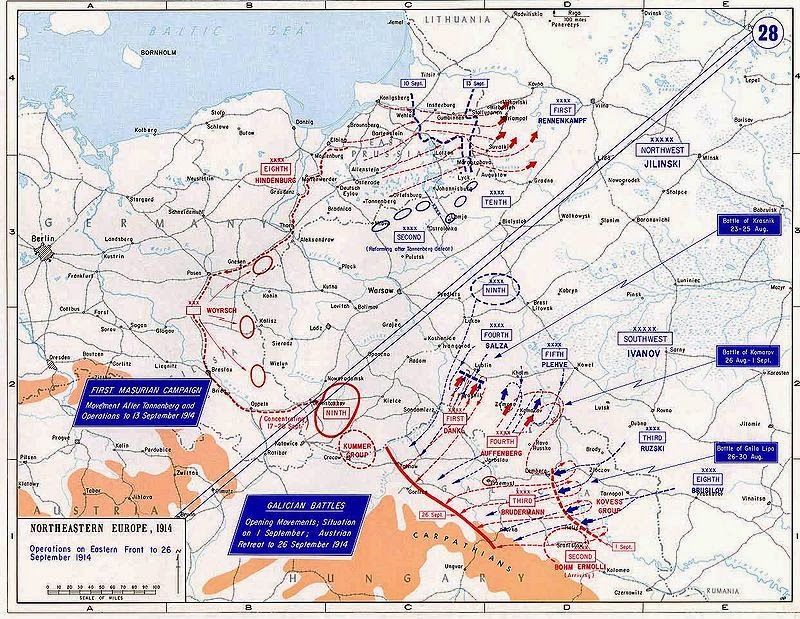
The neutrals were influenced by the Central Powers’ reverses at the Marne and Lemberg – Roumania stayed neutral, and Italy kept out. Falkenhayn was determined to continue his modification of the Schlieffen plan to take control of Belgium and the Channel coast, but faced a major problem in the East, where Germany feared the crushed Austrians might have been about to make a separate peace. He ordered Hindenberg and Ludendorff to reinforce Austria on its northern front, and they sent 250,000 men from East Prussia as a new German 9th Army, which effectively became Austria's central army of three. They faced Russian armies across a 100 mile front that would see complex actions through the winter. 
Grand Duke Nicholas
1856-1929

The Russians were keen to invade southern Poland, and were urged to do so by the French. The Russian Grand Duke regrouped into a strong N-S line on the line of the Vistula. This involved moving a lot of his forces to the north, and he was unaware of the southern movement of the German 9th. However, he was confident that he well placed whether needing to attack or defend from his new line. At the same time, the German success in the north had the Russians on the back foot, and enabled them to move into Russian territory near the Baltic, and to consider moving south to take Warsaw.


Falkenhayn knew he could only re-deploy sufficient  numbers for a strategic defence on the Eastern front because of his need to strike decisively in Belgium. From the outset Russia held an essentially attacking strategy towards Germany, and despite its heavy defeat in Prussia at Tannenberg, still intended to push through Galicia and into Silesia. Their commander-in-chief, the Grand Duke Nicholas, was keen to make this break before winter conditions set in. If he could break through to the line of the Oder, he would threaten both Berlin and Vienna; and would also take control the oil wells of Galicia. 

On their extreme left, this wing of the Russian armies could pushing through the eastern Carpathian passes to enter into north Hungarian plains, and further threaten the Austrian armies. Hungarian defences were weak, since they had suffered terribly at Lemberg, and most of their remaining forces were under siege in Przemysl, or in full retreat towards Cracow. The Russians wanted to control the two main Galician fortresses at Jaroslav amd Przemysl, and the Austrian were desperate to hold on to them, since they guarded the main railways and transport links west to Cracow, and south into Hungary. Jaroslav fell by 23rd September, and by the same date Przemysl was surrounded, although it held out under siege. Dmitrieff, the Russian general, preferred to starve them rather than lose men in storming the garrison. Meanwhile Ivanov had stormed ahead to the west and on 29th his cavalry reached Dembica, around 100 miles east of Cracow, having crossed the River San in large numbers and in numerous places. It was at this time they learned of the German moves southwards between Lowicz and Lodz, and Ivanov withdrew to the east of the San to conform with the Russian lines in the centre.

Russian Artillery action in Galicia 1914


The Russian centre was aligned north and south covering Warsaw and the Polish salient, but the wings were quite disconnected. In the north, Rennenkampf’s army of the right wing was some hundreds of miles to the north east behind the line of the Niemen (today River Nemunas).  Knowing that Germany would send reinforcements to rescue the Austrians in the south, the Russians were keen to lure Hindenberg into pursuit of Rennenkampf into Vilna province (today Lithuania), since it was strategically unimportant to them, and was very difficult terrain. Hindenberg’s pursuit had commenced on 7th September, advancing on a wide front towards the main Petrograd railway. Large parts of his force reached the Niemen by 21st September, but Rennenkampf had stationed all of his army in good defences on the Niemen's east bank. The river itself posed a formidable barrier in several battles that followed as Hindenberg attempted to cross in strength. The Russians lay in trenches on the low eastern shore, and waited until the Germans had built their pontoon bridges before blowing them to pieces. Hindenberg made a final great effort on 27th, following a full day of artillery bombardment, but with the same result, and a huge loss of troops. On 28th, he gave the order to retreat, realising that that this operation risked high loss for little strategic benefit. Retreat was difficult for the Germans, and they were severely harried, losing large numbers of troops in the Battle of the forest of Augustovo, but at least they avoided being encircled and made their escape. The Germans now realised they would have to move reinforcements to the south to prevent the other wing of the Russian armies breaking through to Cracow and beyond, since it had become clear they were going nowhere in the north.

Friday, 23 January 2015

The Eastern Front Part 4 -The Battle of Tannenberg


August 30th 1914 saw France in crisis, with the Germans advancing on Paris and the Government feverishly debating abandonment of the city. In Britain it became known as "Amiens day" - the day the Times published the first honest account of how serious was the overall position and the extent of the British retreat. For the first time the British public were faced with the unpalatable truth, and the impossibility of a short sharp war. And yet, the day was an even bigger disaster for Russia. If Tannenberg was a triumph for Germany, it was a catastrophe for Russia, losing an entire army, and 30th August was the culmination. Ludendorff, ruthlessly ambitious, was quick to claim credit, despite his strong reputation for urging defensive measures only in East, and was widely regarded as the genius of Tannenberg. However, as we have seen, the die was cast for the battle before the new supremos Hindenburg and Ludendorff de-trained at Marienberg, following their breathless journeys from Germany and the Western Front respectively. 

The blue lines show the envelopment of
Samsonov's army

Francois’ quixotic move, against orders, to attack Rennenkampf at the northern end of the front had proved successful at Stalluponen, but not shortly afterwards at Gumbinnen, which had seen one of the few occasions where routed Germans fled in panic to the rear. The news of this had sent Prittwitz into the panic that led to his dismissal. Before he was replaced however, it was the strong views of the senior officers Hoffman, Francois, Below and Scholze that dissuaded him from retreat to the Vistula, and a concentration of the forces at the southern end of the front to await Samsonov’s army. The Germans were greatly aided by access to all the Russian orders, which were transmitted wirelessly and unencrypted because the Russians had no facilities for either.


Samsonov’s orders, repeatedly showered on him by Jilinski were to drive his 2nd army north west, and to the south of the Masurian lakes in order to intercept and cut off, around Alfenstels, the German forces moving on Rennenkampf to the north of the lakes. Nonetheless, Russian armies invaded in both directions during 21st and 22nd of August. Samsonov’s army had marched for days and was exhausted and hungry.
Rennenkampf, after his apparent victory at Gumbinnen, rested, and then moved on only slowly towards the Baltic. Maybe this was because Jilinski wanted the Germans to stay in East Prussia rather than retreat to the Vistula, so that he could cut them off by Samsonov’s advance. He detailed one third of Rennenkampf’s men to stay guarding Konigsberg, and the remainder to press on west to the Vistula. This was disastrous, as it left Samsonov to face the whole German strength, which had been moved south. His forces were markedly inferior and he was smashed. The Germans had sent more reinforcements south, judging that Rennenkampf would not follow to provide much needed relief for Samsonov. The Russians had disclosed their intentions by sending uncoded messages by radio. All this good fortune fell into Ludendorff’s lap as he arrived. Francois was the German general on the right flank charged with taking Usdau to gain complete control over the Russian left flank.
Hindenberg (L) and Ludendorff
leave for the Eastern Front and arrive
just in time for Tannenberg
Ordered by Ludendorff to attack on 26th, when he was not ready, he stalled until 27th. A great battle was fought all day, and won decisively by Francois, taking Usdau. Samsonov, his left and right flanks crushed in successive days, spent the night of the 27th in Neidenberg.  Retreat was his best option. At dawn on 28th the whole German force attacked and more carnage ensued. On 29th Samsonov rode out to the front line near Tannenberg and shot himself.
General disarray and surrender continued over the 30th and 31st – a massive defeat for Russia. Over 120,00 prisoners were taken – more than 60,000 of them by Francois’ corps.


Russian men and weapons captured at Tannenberg
                                  
The Masurian Lakes. After Tannenberg, Samsonov was dead and his army was routed. The Germans turned north to deal with Rennenkampf on the right hand flank towards the Baltic. Strengthened by the troops from France they had 17 Divisions to attack through the line of the lakes and take him head on. Rennenkampf still outnumbered the Germans by 2 to 1, but did not have the right dispositions or intelligence information. By weight of numbers and further reinforcements he built a defensive line against the Germans. They held firm until 9th September when Francois (again) broke through. He took Lotzen, which gave him a clear run to the north and the coast to cut off the remainder of Rennenkampf’s army. On learning this, Rennenkampf ordered a rapid retreat eastwards; with a counter attack by 2 corps to cover it. It worked – he got most of his army back to Russia. Jilinski was relieved of his command after all these reverses, on 17th September

Sunday, 18 January 2015

The Eastern Front Part 3 -The invasion of East Prussia and the battle at Gumbinnen


The Masurian Lakes forced
the Russian advance into a north
and south enveloping strategy
It may be a harsh judgement on a different era, but by today's standards, WW1 Generals come across as insufferably arrogant individuals. Of course there were exceptions, but here is another example of how jealousies between commanders on the same side, compounded by abysmal communications, shaped a terrible fate for one of the combatants - in this case Russia at Tannenberg.
Jilinsky, previously Russian Chief of Staff - very much a HQ man -  commanded the 1st and 2nd Russian armies facing Prussia at the NW end of Russia’s front. He had little time for the two Generals at the sharp end, and was much more concerned about his stock within the political mood music from the centre. In turn, Generals Rennenkampf (1st) and Samsonov (2nd), ranged against a small German 8th Army, had no time for each other (or for Jilinsky for that matter). They were both good generals, but fierce rivals from earlier battles in Manchuria, and neither was minded to put himself out for the sake of the other. Jilinsky's priority was to invade East Prussia with all possible speed. This was mandated by the Russo-French treaty of 1911, and by pressure from St Petersburg (urged on by the hysterical French Ambassador Paleologue), and remote from the realities of terrain, shortage of supplies and almost absent communications.  
Maximilian von Prittwitz

The German commander facing them was Maximilian von Prittwitz, another unpleasant and much disliked character. Prittwitz, nicknamed ‘the fat soldier’ was held in low regard by his younger and more vigorous senior officers. He was outnumbered by 3 to 1 in infantry, and thought to be in a very weak position. However, in addition to having excellent senior officers, including Francois, Mackensen and Below, he had the advantage of the Masurian lakes – a 50 mile stretch of impassable lakes and waterways – that would inevitably split the advancing forces. Using their efficient railway networks, superior equipment and communications, the Germans were able to switch rapidly their forces from one end of the lakes to the other.


Paul von Rennenkampf
The nature of the terrain - marshes and lakes, with few good routes passable for men and equipment - dictated a two pronged advance into Prussia. The plan was for Rennenkampf's army to pass by the north route, whereas Samsonov would pass to the south of the larger lakes. If things went well, this would deliver a classic pincer movement to trap and destroy the numerically inferior German army. This required decisiveness, good communications and co-operation between each claw of the pincer. None of these applied.

Prittwitz was cautious, however. Not unreasonably, he was strongly influenced by Moltke's stern warning that at the very worst he should not allow the Russians to reach the Vistula river, well to the West. He kept one corps in the South, and held the other two corps centrally to cover either move of the pincer.
                                                                                                                 
Alexander Samsonov 
He was persuaded by Francois to send the other forces north to meet head on the advance of Rennenkampf. On what is today's Russian Lithuanina border, they clashed with the Russians at Stalluponen (today Nesterov) and inflicted heavy losses on Rennenkampf. They engaged again, a few miles to the west at Gumbinnen on 20th August. 
Churchill writes “very few people have even heard of Gumbinnen, and scarcely anyone has appreciated the astonishing part it played (in the entire war)”. It was a tumultuous battle, with great German success on the flanks, but rout and panic in the centre as thousands of Germans fled in chaos to the west. News of this had a major effect on Prittwitz 75 miles away in his Marienberg (Malbork) quarters. Despite arguments from his Chief of Staff, Hoffmann, and his generals he resolved to withdraw all his forces to the line of the Vistula river, well to the west. In serious panic, Prittwitz then phoned Moltke, by then deeply involved in battles on the Western front, to beg for reinforcements. Moltke resolved to replace Prittwitz and his deputy WalderseeHe chose Ludendorff and Hindenberg.

(Hastings) “On the afternoon of 22nd August, Eighth Army’s headquarters at Marienburg on the western border of East Prussia received a terse message: Prittwitz was dismissed. The elderly General Paul von Hindenburg had been summoned out of retirement to relieve him; he would be accompanied into the field by a new army chief of staff, the bleak, moody Erich Ludendorff, fresh from his heroics at Liège.
Hindenburg was the man Berlin expected to transform the campaign, selected before Moltke gave a thought to identifying a figurehead commander-in-chief. Ludendorff was a commoner, forty-nine years old, who had risen by sheer ability through the ranks of an army dominated by aristocrats. A dour professional warrior to every extremity of his being, he considered war the natural business of mankind. He had served on the General Staff under Schlieffen, who remained his idol. For a decade he had enthusiastically endorsed the core principle of German planning – that East Prussia should be lightly held while France was disposed of.”  

Herman von Francois
defied Prittwitz and Moltke
to take the offensive
     During Gumbinnen, the Germans had intercepted Russian orders for the whole campaign, and knew of Samsonov's intentions in the south. So until Ludendorff and Hindenburg arrived, Hoffmann and other senior staff persuaded Prittwitz not to flee west to the Vistula, but to use the railway network to concentrate the German forces south of the lakes to face the oncoming Samsonov. This set up the historic battle of Tannenberg.

Most significantly, 25th August was the day Moltke, unnerved by Prittwitz’s panic, determined to send significant forces from the western front to the east. Moltke reasoned that the decisive battle in the west had already been fought and won, whereas two weeks later the forces he released would have provided vital back up at the Marne.

Wednesday, 14 January 2015

The Eastern Front Part 2 - Lemberg

Austria began hostilities by attacking Serbia with two armies (5th and 6th) from the west, in Bosnia, and with the strong 2nd Army on the north bank of the Danube, ready to cross into Serbia. 


Oscar Potiorek had a bad war,
to put it mildly
The incompetent Potiorek, Governor of Sarajevo and bungler of the security for Franz Ferdinand's visit, managed to retain his position via patronage, and commanded the invasion from Bosnia. The Austrian 2nd Army was held north of the Danube initially, havering between invasion of Serbia or transfer north to the Russian front in Galicia. In short, Potiorek's invasion was as disastrous as his security arrangements. One important outcome of this was to keep much of the 2nd Army in Serbia until the 30th August, weakening the forces Austria could bring to bear at Lemberg - an even bigger disaster than their Serbian foray.


The Lemberg actions at the SW of the
Eastern Front

'Lemberg' itself was a composite battle of complex actions in several areas, fought by 3 Austrian and 4 Russian armies over 3 weeks (from 23 August to 13th September) along a 200 miles front. After some initial Austrian success, Russian reinforcements drove back the Austrians, still lacking their additional 2nd army, by nearly 150 miles. Each side lost some 500-600,000 men in several pitched battles.


In brief, the main areas were:

  • The battle of Krasnik 23-25th August was the first major pitched battle. It involved the Austrian 1st and Russian 4th armies. The Austrian success in pushing towards Krasnik on the first day only made them more vulnerable to an encircling move by the Russians, led by Colonel Plehve. Although things were looking good for Conrad to the west of Lemberg, where he reinforced his armies, it was to east of Lemberg where the Russian counter-attack was gathering. From the 26th two new battles thirty miles apart began and raged. The whole Austrian front was involved.
  •  In the second battle – of Komarov – the Austrians looked set to encircle the Russians, but they walked straight into a massacre, which killed great numbers of Austrians, and destroyed what little faith the army had in its own prowess.
  • The battles of Gnila-Lipa. Initially, on 26th August, three Austrian corps, XII, XI and IX, advanced against the Russian 8th army. Repulsed and destroyed by the Russians everywhere, they retreated to Lemberg. A second phase was fought on 30th Augustin front of Lemberg on a line of the Gnila Lipa river. The Austrians had re-grouped, and the Russians had been hesitant in following up their earlier success. However, overwhelming bombardment by the Russians broke through, and the Austrians retreated further in chaos towards Lemberg.
  • Although outweighed by its crushing defeats near Lemberg, where over two million men had fought, Austria nevertheless rallied strongly at the northern end of the front, moving back towards Komarov. Indeed, by August 31st, Auffenberg was  poised to take a great victory at Komarov against the Russian army, which was enclosed on three sides. Instead of closing the trap, the Austrian flanks (both controlled by Archdukes) reacted cautiously to (false) reports of Russian reinforcements, and pulled back. This left a 20 mile gap through which Plehve could retreat his army safely.
  • Then on 1st September, Conrad ordered Auffenberg to turn south, and join up with the remains of the 2nd Army to take on the Russians again at Lemberg. They might have been obliterated in such an action, but for the news reaching Russia of German advances from Eastern Prussia. The Russians responded by moving much of their strength to the west towards Prussia and away from Lemberg. This led to a re-aligned front running north to south, with the Austrians stronger than the Russians in the south.
  • A climax to the battles along this whole front occurred on 9th September. By the 11th, there had been huge losses, and the Russians had got in behind the northern end of the Austrian front. The risk was severe, so the Austrian 2nd 3rd and 4th armies retreated. Conrad’s order, accepting defeat, was issued at almost the same time as Moltke’s acknowledging defeat at the Marne. Demoralised after Lemberg, the Austrians fell back behind the River San, except for the fortress town of Przemysl, subject of a famous siege. They continued the retreat to the Carpathians and westwards towards Cracow and the Vistula. Conrad managed to form a defensive front before the Vistula, but it was a ragtag, polyglot army, more than 300,000 men fewer than when it had started. 
"Shackled to a corpse"
Two Kaisers, but a very unequal alliance.

Effectively, Austria was now finished as a major fighting force and completely reliant on Germany. It was round about this time that Falkenhayn made his famous comment about Germany’s alliance with Austria akin to being “shackled to a corpse”.

Sunday, 11 January 2015

The Eastern Front Part 1 -

Considering the scale of the battles and the resources committed to the Western Front during these first months, it is remarkable that Germany could be engaged in actions of a similar scale and significance on here eastern front. In the east support came from Austria-Hungary, numerically strong if not militarily. 
Hawk - the aristocrat Conrad repeatedly
called for war, but was unsuccessful in
waging it
The decaying Habsburg Empire was culpable, though not solely, in the escalating series of events leading to the outbreak of war. First to declare war, against Serbia on 28th July, but last to be drawn into the main conflict on August 12th, Austria had  become determined to crush Serbia long before the assassination on 28th June. Ironically, Franz Ferdinand had been the most likely person to pursue a diplomatic solution to the Balkan crisis, and was about to dismiss the Austrian C-in-C - the unpleasantly bellicose Conrad von Hotzendorf - for his constant war mongering.  
There were more 'fringe' players in the eastern theatre in 1915 than in the west. Italy stayed out initially - refusing to join the central alliance - partly because she did not want war with Britain or France and partly because of ongoing territorial disputes with Austria. Since Austria had triggered events by declaring war on Serbia, Italy did not feel bound by the Triple Alliance treaty with Germany and Austria. The Balkan states, plus Rumania, Turkey and Greece were all at differing stages of preparedness for the conflict.
The attack by Austria on Serbia was the prelude to major actions in two areas of the Eastern Theatre: running east to west in Galicia, north of the Carpathian mountains, Austria and Russia faced each other; and north to south in Russian Poland and East Prussia, Germany and Austria were opposed. 
Unlikely Dove? - the autocrat
Franz Ferdinand, heir to the
crumbling empire


Austria needed to finish off Serbia as fast as possible, in order to bring maximum resources to bear for the fight with Russia. Germany had initial expectations that Italy, as part of the triple alliance with Austria, Rumania, Bulgaria, Turkey and Greece would all line up with Austro-German central axis. 
As matters transpired, the neutrality of all of these was still in the balance by the year end. Italy declined, and Rumania followed suit, despite its King’s strong ties with Germany and his preference for declared alliance with them. Greece and Turkey were too intimidated by the British Fleet, which left only Bulgaria likely to declare for the central alliance. Portugal and Japan had declared alliance with Britain, though not as belligerents in the war.
All of this meant that it was essential for Austria to crush Serbia rapidly to win over the waverers. Conrad selected his Plan B (Balkan) for Serbia (3 of Austria’s 6 armies to invade Serbia, leaving 3 to guard v Russia in the North) rather than Plan R(ussia) (2 armies v Serbia, 4 v Russia). He justified this by arguing that Serbia had forced war forced on Austria, and he did not want to be seen as responsible for triggering a world war, only to pursue Serbia. 
On 28th July Austria declared v Serbia, and the 3 armies moved. Austria had 18 Divisions and geographical supremacy against Serbia’s 11 Divisions. Potiorek (of Sarajevo disrepute) was in charge of two armies, the 5th and 6th, due to invade from the west, and the 2nd approached from the north.

Kaiser Wilhelm was unhappy about Plan B, and contacted directly the Emperor Franz Joseph, urging that Austria should settle with Italy to bring her into the triple alliance, and put the great majority of her forces into the front developing in Galicia facing the Russians. This pressure effectively converted Conrad's Plan B to Plan R, but the Austrian 2nd army was already on trains to the Serbian border on the Danube, and could not be recalled.

The Austrian line for war with Russia put their armies in the plain of Galicia, north of the Carpathian mountains, and south of the two rivers San and Dniester. Their path of retreat if unsuccessful was to be through an eastern pass of the Carpathians, or to the west, through Cracow and Bohemia – "the Moravian gate". Conrad’s Plan R would give him a good numerical superiority over the Russians, but with Plan B already underway, he would have only parity of numbers. German support was promised, but Conrad would need to make good progress in order for his left flank to link up with the German right flank in East Prussia. He hoped the Germans would move much further south towards him, but was disappointed, as they decided to concentrate their actions in the north, towards Kovno. Not for the last time Conrad found himself in a sticky position, with his own 2nd army stuck in Serbia. An Austrian cavalry reconnaissance, attempting to discover Russian movements across a 300 miles front from Mohilev to Lublin was futile, and uncertainty abounded.

The Russian mobilisation began following the Czar’s order on 30th July. Five million men from all parts of Russia were converging on the Eastern front. Plan G ‘Germania’ was for a major, head on conflict with German forces. Plan A ‘Austria’ envisaged Germany pre-occupied in the west, and only defensive on her Eastern front. In both plans, the Polish salient would be evacuated at the outbreak of hostilities, to present a united front. If necessary, the strategic retreats of 1812 would be repeated to buy time, and to stretch the German lines. Grand Duke Nicholas, uncle of the Czar, assumed command of all Russian armies on the front. Initially he tended towards the more defensive formation, but the 1911 agreement between Russia and France mandated Russia to move into Germany if Germany invaded France. France invoked this agreement, and Duke Nicholas created two extra armies to strike towards the German border on a line between Thorn – Posen – Breslau.

Hence, the scene was set for the two major battles in the east to follow the Serbia curtain raiser - Lemberg and Tannenberg.