Sunday, 22 October 2017

The Russian Revolution 4: - Lenin's October Revolution

Vladimir Ilyich Ulyanov -
Lenin, undisguised
The previous post on Russia (See 27/8/2017) described how the public mood lurched from one extreme to the other during the chaos of the July days; and how violence, looting and anarchy threatened society across Russia in different ways. Kerensky remained Prime Minister of a shaky Provisional Government (PG) and was still a threat to those who would wish to usurp him. Kornilov’s military coup had been snuffed out, and he had been succeeded as head of the Stavka (army) by the more dependable Alexeev.  Across the border in Finland, Lenin was hiding away from the warrant for his arrest issued by Kerensky. He was nevertheless attempting to orchestrate the overthrow of the PG, knowing that this would likely provoke civil war across Russia – something he felt was necessary for a true proletarian revolution to succeed. The more democratically minded Bolsheviks in the Petrograd Soviet, led by Kamenev and Zinoviev, were strongly opposed to such an uprising, mainly for fear of being destroyed by an overwhelming counter-revolution (as had happened to the communards in Paris in 1871).
In late August, the Petrograd Soviet passed the Bolshevik resolution “On Power” (including Lenin’s slogan “All power to the Soviets”) as tensions increased in the frail partnership between PG and Soviet. The Moscow Soviet backed this a few days later, and by mid-September more than 80 Soviets in large towns and cities had backed the call, and the slogan. In most of these Bolsheviks were outnumbered by Socialist Revolutionaries (SRs) and their factions; Mensheviks and others. However, the Bolsheviks tended to be the most vocal and influential, and often gained themselves majority positions on executive groups. Overall there was a strong consensus supporting the Petrograd Soviet’s call for an All-Russia Congress of Soviets to establish a position on national government. Nevertheless, as the weeks passed uncertainly, there was a growing political awareness and militancy among the workers (influenced more by the touring Trotsky than the exiled Lenin). Violence, looting and pogroms were widespread and it seemed anarchy would replace democracy. The conditions were turning in Lenin’s favour.

Still the leadership of the Soviet did not react to the changing positions, and take the opportunity to challenge the PG’s weak position. Kamenev issued a call for the All-Russia Soviets congress to take place in Petrograd on October 20th (2nd November Gregorian*), at which the coalition of revolutionary groups would determine their position regarding national government. Lenin, presumably seething with frustration, risked a return to Russia, to Vyborg 80 miles north of Petrograd, to communicate better with his erstwhile colleagues. From there, he harangued Kamenev and others with letters urging an uprising before the Congress. He was convinced the Bolsheviks had to lead, rather than be a minority partner in a Soviet leftist coalition. His demands became more strident, and he was obliged to drop his “all power to the soviets” slogan. His absence from the hub of activity at this time clearly impacted on his influence.
Kamenev (r) and Zinoviev. Men of principle
but not equal to the resolve of Lenin.
Without his input, a ‘Democratic conference’ was held on 14th September to guide the Petrograd Soviet’s stance in negotiating with Kerensky about his new PG. In practical terms this was a disaster. No firm conclusion were drawn as, again, the intellectuals of the movement argued over principles and dogma. Kerensky was left free to reshuffle his PG giving even less influence to the Soviet than in the previous version. Lenin’s best support at this time came from Trotsky, whose recent conversion to Bolshevism allied to his brilliant rhetoric was influencing the proletariat that Lenin wanted to arouse. At the end of September Lenin went public with his letters, openly denouncing the Soviet leadership as “miserable traitors to the proletarian cause”. Kamenev called for Lenin’s arrest, and re-issued his decision that no precipitate moves should be planned pending the Congress on 20th October.
The fuse for John Reed’s “Ten Days that Shook the World” ** was now lit. On 10th October, Lenin returned to Petrograd disguised as a pastor, and took a room in a party worker’s apartment. From there he convened a secret meeting of the Bolshevik Central Committee (ironically in the house of a prominent Menshevik whose wife was a devotee of Lenin). Only twelve of the 21 members of the committee were able to attend to hear Lenin’s urging for an uprising before the Congress. However, they supported it by 10 votes to 2. The dissenters were Kamenev and Zinoviev. They had been upstaged, but no date for the action had been set, and the full committee would decide.
Lenin’s plan was for the ‘northern’ Soviet’s pre-Congress meeting, scheduled for 11-13th October in Petrograd to provide the vote for the uprising. He thought he had them in his pocket (he had not been wasting his time in the north), but Kamenev attended and struck back with a resolution that passed – namely that Congress should decide on 20th October, and not before.
On 16th October (29th Gregorian) the same drama played out at the Bolshevik Central Committee, housed in Smolny Palace. This time Lenin was present and his influence carried the day. A majority of the full committee backed his proposal. Kamelev resigned amid bitterness and rancour, and he now went public with his grievances. The Soviet leadership, alarmed by the development, postponed the Congress by five days in order to bring in more of their own (non-Bolshevik) members from distant Soviets.
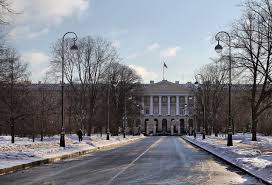
The Smolny Institute. Formerly an
institution for daughters of the rich,
a hotbed of Bolshevik politics in
late 1917
But Lenin’s proletarian revolution now had the momentum and he was able to use the additional time to prepare his actions in Petrograd. He put Trotsky in charge of the local Military Revolutionary Committee (MRC), ostensibly as a protective move for the Soviet (in fact it was a purely Bolshevik vehicle). Kerensky’s erratic response was to declare war on the Bolsheviks, and to order the Petrograd garrison to the war front 100 miles away (the latter because he doubted their loyalty and was considering moving the PG to Moscow). His move backfired badly. The garrison refused to leave the city and fell straight into the arms of the MRC. This, on 21st October (3rd Nov Gregorian), was the first act of the insurrection. By 23rd they had occupied the St Peter and Paul Fortress, and thereby control of the artillery overlooking the home of the PG – the Winter Palace.
By the time the fabled (and delayed) All-Russia Soviets Congress started on the morning of 25th (8th  November Gregorian) the PG was locked in the Winter Palace, surrounded and defenceless. Key buildings and services had been taken over. Lenin's power seizure was at hand. Like the Democratic conference in September, the Congress proved to be a shambles, working perfectly in Lenin’s favour. The Mensheviks, SRs and some of the moderate Bolsheviks walked out of the meeting in protest at Lenin’s coup, foregoing a final chance to argue the position round to a coalition Soviet government. Lenin had the initiative. Where most people expected him to lead a Soviet government ahead of an elected Constitutional Assembly (still the holy grail since the February Revolution), Lenin instead created a Council of People’s Commissars (Sovnarkom). All fifteen of its members were Bolsheviks.
The Sovnarkom announced Constitutional Assembly elections for January 1918, and these duly took place with nearly 50 million people voting. The results were both fascinating and meaningless. Fascinating, in that approximate results were: SRs 38%; Bolsheviks 23%; Kadets 5%; Mensheviks 4%; and nationalist non-Russian parties 17%. Meaningless, because in the intervening three months Lenin’s Bolsheviks had gone a long way to establishing a one-party state by seizing control of national institutions and local Soviets; and by fomenting violence, looting, repression and revenge.

At its convocation in January 1918, the Bolsheviks, signalling their intention to defend what they had seized, immediately closed the Constituent Assembly, and civil war became inevitable. By conviction, determination, improvisation and strength of character Lenin had become the most significant revolutionary leader in history. Russia’s experiment with democracy was over. The October Revolution had seized power with even less bloodshed than the February event. But what followed – in mob violence, the ‘Red Terror’ and a prolonged civil war – was far worse.

* NB Russia still used the Julian Calendar until the following year. Its dates run 13 days behind the Gregorian Calendar
**  Communist and Journalist John Reed's eye witness account of those momentous events conveys powerfully the confusion and volatility of the time.

Wednesday, 11 October 2017

Third Battle of Ypres Part 3: Passchendaele - the Pyrrhic victory

The liberated rubble of the church at
Passchendaele November 1917
Repeatedly in this blog I have been critical of British C-in-C Sir Douglas Haig or, at best, been unsympathetic to the enormous responsibility he held with little or no opportunity to pass the buck. But he had a hellish job that few people would have wanted to take on. As his senior Generals Plumer and Gough pleaded with him to stop, or at least suspend, the bloodbath in the Ypres mire, he must surely have thought it the path of least resistance. He knew his favoured strategic breakthrough to the Belgian coast was lost, but he had to weigh this against keeping the Germans as fully occupied in Flanders as possible, while Petain’s main French forces recovered in Artois for another sally on the Aisne heights; and his own 3rd Army, under Byng, prepared for a tank led breakthrough attempt at Cambrai. The scale of casualties in his forces to date had been worse than at the Somme, and the state and morale of Gough’s 5th army were both of serious concern. He knew men had been withdrawn from the Belgian coast in favour of Italy (by an unsupportive Prime Minister), and that further men would need to be moved from Flanders to support the Cambrai action. Somehow he had to persuade Gough and Plumer to convince their own men to continue towards what could now be no more than a tactical victory to control the heights of the Ypres salient. Seemingly, he did not waver.

Buchan describes the last stages of Ypres 3 as the “muddiest combats known in the history of war” – as if it hadn’t been bad enough already. Haig’s concession to the combined appeal of Gough, Plumer and all their senior officers was to order Currie’s Canadian Corps, further south, to come under Plumer’s command and become the spearhead for the ‘final push’ to Passchendaele. Their commander Lt. General Currie was a tough competitor – the Dominion of Canada’s first great military hero. His men were still relatively fresh, having recently captured Hill 70 near Lens as part of Byng’s diversionary action (see post 31/7/2017). Currie was not in a position to defy Haig’s order to move his men to Flanders, but he did refuse to let them loose on the morass of the Passchendaele ridge until his full preparations had been made – causing further unwanted delay for Haig.
Overall, in the final month of Ypres 3 the scale of fighting was much less than in the earlier phases. The main thrust to the village from the west would be entrusted to the Canadians. To the south the ANZACs (2nd Army) pushed on through Zonnebeeke to the vanished hamlet of Nieuwvemolen. To the north the British Guards, the Royal Naval Division (both 5th Army|) and the French 1st army progressed eastwards – the British taking Poelkapelle and beyond; and the French doing even better, penetrating the large Houthulst forest north east of Langemarck. These advances on the flanks were important in preventing artillery and enfilade attacks against the eventual Canadian advance.
Arthur Currie: a stalwart leader of his
countrymen at Ypres 2 and 3
Currie’s plan was that, if the weather was tolerable and every available man would support his preparations, he would be ready to move in late October. Plumer gave his backing to this, shielding Currie from Haig’s impatience. In the interim some futile attempts on the broader front were continued by Gough’s 5th army, from Polygon Wood to Langemarck. Incremental gains were made on October 8th and 9th, but further torrential rain on 11th precluded any further progress. Even a day or two with no rain made no difference in some flooded areas. One observer wrote “You might as well try to empty a bath by holding lighted matches over it”*.
On 25th October, helped slightly by a strong following wind that at least dried out the surface mud on the slopes, the Canadian infantry began to move up the line. Early on 26th they attacked toward the hillock south of Passchendaele, aided by the flanking activities described above. Their objective was carried by the early afternoon. On their right flank the British entered Gheluvelt for the first time since the initial battle for Ypres in late 1914. Further progress to Passchendaele was held up for two days in fierce fighting for a shattered piece of woodland, aptly named Decline Copse. The Canadians and Australians both ended up attacking this stronghold, and eventually took it, but with heavy casualties.
The final assault on Passchendaele itself began on 30th October. The Canadians took Crest Farm on the southern edge of the village (site of the memorial today), but the Naval Division on their left could not advance across the treacherous hinterland to join and strengthen them. Again, Currie insisted on a further pause for reinforcements for his men before the final 200metres advance to the centre of the village. This duly happened on 6th November, when the bolstered Canadian 1st and 2nd Divisions swept past the ruins of the church and beyond the village to the Goudberg spur. A final attack on 10th November secured this spur and marked the official end to the terrible Third Battle of Ypres.
Haig had reached his target, 99 days after the 31st July jump-off from his starting line 5miles to the west. It was five months since the drama at Messines Ridge, and more than half a million men from both sides had died, been injured or disappeared in the mud. Haig had his momentary tactical victory and another strategic failure.
Passchendaele Church, rebuilt on the rubble.
A moving tribute to events of 1917
By any standards – and Buchan does his best to offer a patriotic rose coloured hue to the outcomes – the capture of Passchendaele was a Pyrrhic victory, like the Somme. Accurate casualty figure are still elusive, 100 years on, but it seems likely they were in excess of 350,000 for both sides. Undoubtedly, the Germans suffered terribly (as they did eventually at the Somme), but Gough’s brave 5th Army was all but broken by the ghastly attritional mud-churn of the battle.

Before the end, whole divisions were being moved to France, for Cambrai, and to Italy to support the strategic opportunity there. At least (it might be said) the British now controlled all the high ground around the Ypres salient for the first time since 1914. But the final insanity of Ypres 3 came within a few months, as all the ground won in those five months of battles was ceded without contest in the great German Spring offensive of 1918. The Ypres salient would be reduced to the remains of the town and its outskirts. This was just the line proposed in 1915 by the unsung General Horace Smith-Dorrien after the gas attacks of Ypres 2.  HS-D was sacked for his temerity. Perhaps he should have been promoted over Haig?

* Buchan J. A History of the Great War Volume 3 p599

Sunday, 1 October 2017

Third Battle of Ypres - Part 2: August and September

A familiar image of the horrors of Passchendaele
The biblical rains of early August transformed an already churned and bleak landscape to a morass of glutinous mud. For men holding the front lines, existence was sheer misery - in many places with hundreds of corpses strewn about their immediate vicinity. For those charged with supplying and reinforcing the front line the prospect was just as unattractive. The German artillery still overlooked most positions including the main route from Ypres - the Menin Rd. The routes themselves were dangerously flooded. Duckboards picked out hazardous pathways for men, horses and equipment but heavy losses of all three groups occurred in the mud and howling rains.
Rawlinson's army had now taken up position, replacing the Belgian contingent at Nieuport on the coast. They were ready to join the planned amphibious assault on the U-boat bases at Ostend and Zeebrugge when the signal was given. However, they needed Haig's forces to make the breakthrough behind the German lines and beyond Passchendaele before they could do so. Despite the encouraging progress of 31st July this had from the start been unlikely and, in the presence of the current weather conditions, was rapidly becoming impossible.
With the enforced hiatus, the third battle of Ypres became, in fact, a series of smaller actions focusing on the succession of small ridges leading to the highest point of Passchendaele. Whole divisions were sacrificed through death, injury and exhaustion for the attainment of small tactical objectives. Byng's army at Loos in Northern France started a partially effective diversionary campaign to draw off German reserves, but both sides nevertheless suffered massive casualties over possession of the small, infamously named village of Passchendaele.


Other than consolidating, as best he could, the gains of 31st July, Gough could do little to meet his commander’s wishes for a breakthrough. He somehow managed to retake the village of St. Julien on 3rd August, and to improve the position across the Steenbeek stream/torrent in that area, but it was not until mid-August that a few days good weather dried out conditions sufficiently for them to have another serious crack against the line. Gough’s four army corps were pushed forward again on 15th August against the next tier of ridges en route to Passchendaele, from the Menin Road spur near Gheluvelt north to Langemarck.
Some success was achieved at the northern end, where advances to Langemarck and the hamlet of Wijfvegen were made. Between St. Julien and Frezenberg the German defence, heavily fortified with pillboxes, exacted very heavy casualties on the British attackers. At the southern end, by the Menin Rd, the winding ridges converged on the spur know as Hill 64, close to a hectic and battered crossroads known by the troops as Clapham Junction. Here, progress was difficult, through Inverness Copse and Glencourse Wood towards the large Polygon Wood (all of which were devoid of trees by this time). German defences were strong; heavy artillery overlooked the British communication lines, and losses were high. In the later part of the month heavy rains returned, and by the end of August Gough’s army was exhausted and dispirited, and not yet halfway towards its target.
Most tanks at Ypres 3 ended in a
watery grave
Tanks that had been sent to support the advance were completely inappropriate for the terrain or the conditions, and most were stuck in mud and out of action. Gough reported the difficulties and loss of morale to Haig. Rather than accept the futility of continuing, Haig turned to Plumer’s 2nd Army to take the heat off Gough’s men.
Plumer employed his customary thoroughness to the planning of what became known as the Battle of Menin Road. Resources, especially artillery, were  built up behind huge screens, and new tactics were developed to deal with the pillboxes problem behind German front lines. Plumer’s aim was to advance a further mile down the Menin Rd past Gheluvelt, to pressure the German positions around Zonnebeeke; and to support and relieve those pushing eastwards from St. Julien and Langemarck/Poelkapelle. September 19th was set as the day for the next effort, and at dawn the broader advance began. The addition of Plumer’s forces and organisation made a difference and by mid morning all first objectives had been achieved. The formidable Bremen redoubt had been taken, and the outskirts of the town of Zonnebeeke had been reached. Fierce attack and counter attack continued for a week before a new British surge was launched along the same 6 miles stretch. The rest of Zonnebeeke and Polygon Wood were taken – the latter by an Australian division under Plumer’s command. The weather held until early October, and the gains made were consolidated. Exhaustion and the desperate use of reserves were now affecting both sides, and by the time the next phase opened on 3rd October, so were the returns of gales and lashing rain.
The slow grind to Passchendaele
(Source: Major and Mrs Holt's Battle
Map Ypres Salient and Passchendaele)
The British were aiming for control of the ridge running north from Broodseinde to Graventafel (where Tyne Cot cemetery stands today). On their side, the Germans were aiming to counter attack towards Zonnebeeke.  They had just assembled three fresh divisions in the trenches to go over the top when the British artillery bombardment opened up, causing terrible destruction. They were in complete disarray as the British and ANZAC troops attacked. After another day of severe fighting the British held Poelkapelle; the New Zealanders were in Gravenstafel, and the Australians had taken Broodseinde. Passchendaele was finally in sight.

But the costs were ghastly, and the weather was worsening. On the morning of 7th October, after a night spent in deep discussion, General Gough and Plumer travelled to Haig’s headquarters and jointly requested that the campaign be halted.  Remarkably (or perhaps not so) Haig refused. He ordered that, in the light of the successes three days earlier, the campaign would continue. His only justification for continuing was tactical. He knew that the strategic breakthrough to the coast to join an amphibious operation against Ostende and Zeebrugge was now impossible. He knew also that Lloyd George had lost interest in the Flanders campaign and was ordering Rawlinson to move men and resources from Nieuport to Italy. Yet again, Haig trotted out that dreadful WW1 phrase “One more push”.